Long Torso or Long Legs: Why Tall Sizing Fails Two Completely Different Ways
Quick Answer: Height is two measurements pretending to be one. Your torso length and your inseam vary independently, so two women at 5 foot 10 can need opposite alterations. The quick test: sit on a hard chair and measure floor to the top of your head. If that seated height is more than about 53 percent of your standing height you are long in the torso; below about 51 percent, you are long in the leg. Tall sizing extends the leg, so it only solves half of the population it claims to serve.
This is why some tall women swear by tall ranges and others find them useless. You are both right - you just have different bodies wearing the same label.

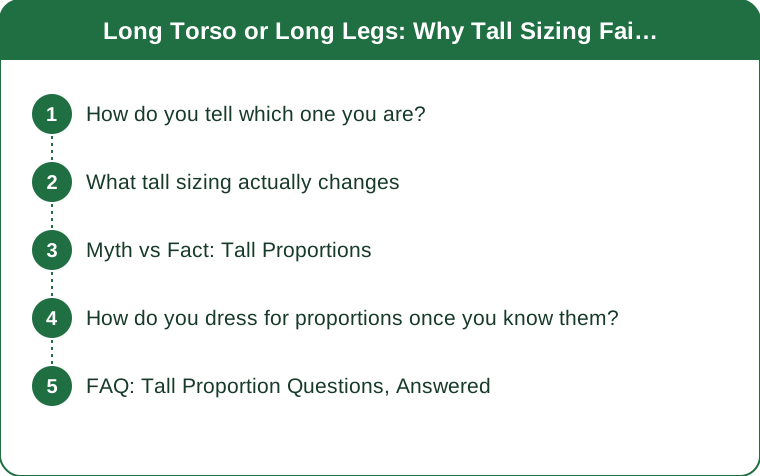
How do you tell which one you are?
There is a two-minute version and a precise version, and both beat guessing.
The seated height test. Sit upright on a hard, flat chair with feet flat on the floor. Have someone measure from the floor to the top of your head. Divide by your standing height.
- Above roughly 0.53 - long torso relative to legs
- Roughly 0.51 to 0.53 - proportionally average
- Below roughly 0.51 - long legs relative to torso
The inseam cross-check. Measure your inseam from crotch to floor in bare feet. The average inseam for a 5 foot 8 woman sits around 31 inches. If you are 5 foot 10 with a 31 inch inseam, your extra height lives in your torso. If you are 5 foot 8 with a 34 inch inseam, it lives in your legs.
The everyday diagnostic that costs nothing. Think about what actually goes wrong when you buy standard sizes:
- Trousers end above the ankle, tops are fine - long legs
- Trousers are fine, tops ride up and bodysuits pull uncomfortably - long torso
- Waistbands sit lower on you than on the model - long torso, almost always
- Sleeves are short but tops are long enough - long arms, which tracks with long legs more often than not
The last one matters because arm length and inseam correlate reasonably well, and torso length runs somewhat independently of both.
What tall sizing actually changes
Most brands treat tall as a single lever, and it usually is.
When a brand grades a garment into a tall range, they typically add length below the hip and at the sleeve, and leave the torso rise and the shoulder-to-waist measurement close to standard. The waist of a tall trouser sits at roughly the same proportion of the body it always did; the leg just got longer.
For a long-legged woman this is exactly right. Trousers finally reach the floor, the rise still hits the natural waist, and the whole thing works.
For a long-torsoed woman it is the wrong lever entirely. Her trousers were already close to long enough. Her problem is that the rise is too short, so the waistband sits below her natural waist, dragging the visual line down and creating that specific tall-woman complaint of trousers that fit but look wrong. Buying tall gives her too-long legs and the same short rise.
What long-torso bodies actually need:
- High rise, and genuinely high - a 12 to 13 inch front rise rather than the 10 to 11 inch that gets marketed as high rise
- Tall or long-length tops, which some brands sell separately from tall trousers - this is the item worth hunting for
- Bodysuits in tall or long sizing, because a standard bodysuit on a long torso is genuinely uncomfortable rather than merely unflattering
- One-piece swimwear in long-torso cut, which is the single most obvious case and the one most brands do label properly
If a brand offers a tall range but no long tops, it is serving long legs only, whatever the marketing says.

Myth vs Fact: Tall Proportions
Myth: Tall women all have long legs. Fact: Height is distributed differently in every body. Plenty of tall women have average inseams and unusually long torsos, which is why the tall range does not work for a meaningful share of the people it is aimed at.
Myth: A long torso means you should avoid high-waisted anything. Fact: The opposite. High rise is the tool that puts the waistline back where it belongs. What you should avoid is a rise labelled high that measures like a mid rise on you.
Myth: Alterations can fix any of it. Fact: Lengthening a leg is limited by the hem allowance, and shortening a leg is straightforward. Rise is very difficult to alter and torso length in a top is essentially impossible to add. This is why buying for torso and altering the leg is nearly always the better order of operations.
Myth: Proportion is why some outfits look off, and it means something is wrong with your body. Fact: It means a garment designed around one ratio was put on a different one. That is a manufacturing default, not a verdict.
How do you dress for proportions once you know them?
The point of knowing is not to hide anything. It is to stop buying the wrong lever.
If you are long in the torso:
- Buy high rise everything and check the actual rise measurement rather than the label
- Tuck deliberately - a front tuck or full tuck sets the visual waist yourself rather than letting the garment set it low
- Belt at the natural waist when a garment insists on sitting low
- Choose tops labelled tall or long even if you buy standard-length trousers - mixing ranges is normal and nobody can tell
- Watch dress waist seams, which will land below your waist on standard sizing and are the hardest thing to fix
If you are long in the leg:
- Tall trousers are genuinely your answer and worth paying more for
- Check the crop. A style meant as a crop on standard sizing becomes a proper ankle length on you, which is often better than the version you were aiming for
- Boot shaft height and heel need checking together, since a shaft graded for a shorter calf ends up mid-calf on you
- Standard tops usually fit, so spend your search energy on the bottom half
For both: buy for the measurement that cannot be altered and alter the one that can. Leg length is the easy alteration. Rise and torso length are not.
FAQ: Tall Proportion Questions, Answered
How do I check the rise before buying online?
Most size charts list front rise. Compare it against a pair you already own that sits where you want it. Measuring your own favourite pair takes 30 seconds and turns online buying from guesswork into arithmetic - measure from the top of the waistband down the front seam to the crotch seam.
Are activewear brands better or worse at this?
Usually better on rise and worse on length. High-rise leggings are the norm now, which helps long torsos considerably, but very few brands offer a genuine tall inseam, so long-legged women end up in leggings that read as a 7/8 length. Look for brands that publish inseam in inches rather than descriptions like full length.
Does proportion change over time?
Inseam does not, but the way clothes sit on you does - posture, changes in body composition, and pregnancy all move where a waistband lands. If garments that always worked suddenly do not, remeasure before assuming the brand changed its sizing, though brands do also change sizing without announcing it.
TL;DR:
- Height is two independent measurements: torso length and inseam
- Seated height above about 53 percent of standing height means a long torso; below 51 percent means long legs
- Tall ranges lengthen the leg and rarely lengthen the rise, so they only fix half the problem
- Long torso needs genuinely high rise and tops sold as tall or long; long legs needs tall inseams
- Buy for what cannot be altered - rise and torso length - and hem the rest
Most of what feels like a body problem here is a ratio problem in the pattern, and once you know which of the two you are, the whole shopping process gets shorter. You are not hard to fit. You are being graded off the wrong ratio.
See It in Motion
Seen here: High Waist Yoga Leggings with Inner Pocket — shop it on bubblelime.com
Keep Reading
This article is for general informational and styling purposes only. Fit, sizing, and product availability may vary.
