Why Autumn Boots Never Fit Tall Women — and What Actually Solves It
Quick Answer: Boot shaft height is usually graded from a single size-8 sample and scaled minimally, so a tall woman’s longer calf gets a shaft designed for someone four inches shorter. Look for shaft height listed in inches rather than described as ‘knee-high’, check calf circumference measurements against your own, and consider that the widest part of a tall calf sits higher than most boots account for. Extended-calf and tall-specific lines exist and are the only reliable fix — alterations to boot shafts are expensive and limited.
Every autumn, the same routine: order three pairs, and all three hit somewhere between mid-calf and the widest part of your leg, which is the single most unflattering place a boot can end.
It isn’t your legs. It’s a grading decision made in a factory that assumed your calf was where a shorter woman’s calf is.

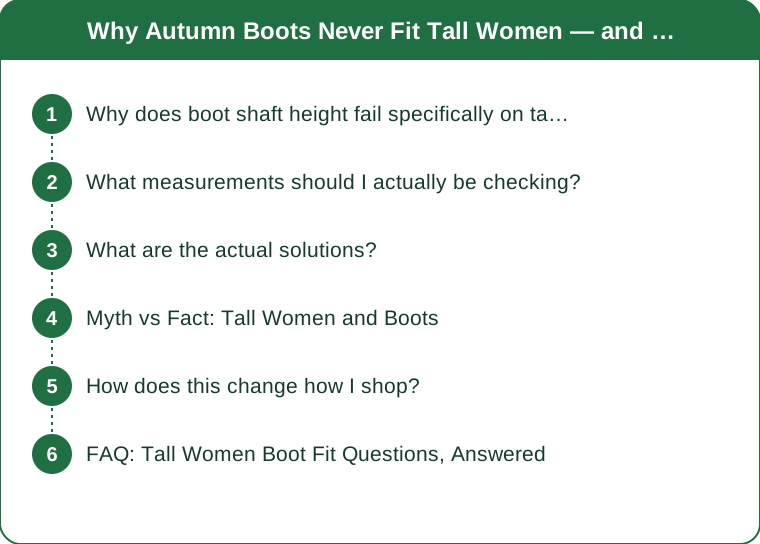
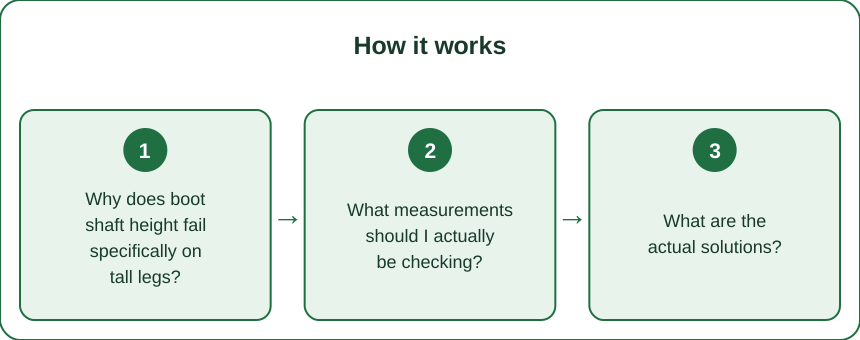
Why does boot shaft height fail specifically on tall legs?
Because shaft height barely changes across the size run, while leg length changes considerably.
Most brands design on a size 7 or 8 sample foot and then grade up and down. Foot length grades reliably; shaft height often grades by a quarter inch per size or not at all. A size 11 boot may have a shaft only half an inch taller than the size 6.
Meanwhile the leg it’s going on is several inches longer. A woman at 5’10” typically has a calf whose widest point sits 1.5 to 3 inches higher than a woman at 5’4”, and a knee crease higher still.
The result is systematic: a boot marketed as knee-high lands at mid-calf, and a mid-calf boot lands at the widest part of the calf — visually the worst possible termination point, because it cuts the leg at its broadest.
Calf circumference compounds it. Standard boot shafts are built for a 14 to 15 inch calf, and a taller frame frequently carries more calf circumference even at the same body composition. The shaft is simultaneously too short and too narrow, and the narrowness is worst at the top because that’s where a longer leg is still widening.
This is a manufacturing economics problem, not a body problem. Extended shaft grading requires separate patterns and separate lasts, and most brands decline the cost.
What measurements should I actually be checking?
Three numbers, and almost no brand gives you all three — which tells you something about who they’re designing for.
Shaft height in inches, measured from the arch. For a knee-high look on a 5’9”+ frame, you generally need 16 to 18 inches. Standard boots list 14 to 15. If the listing doesn’t give a number, assume 14.5 and assume it will disappoint you.
Calf circumference at the top of the shaft. Measure your own calf at the height where the boot will actually sit — not at the widest point, which may be below the shaft top on a tall leg. Add half an inch for jeans, more for thick socks.
Where your own widest point sits. Measure from the floor to the widest part of your calf. On most tall women this is 13 to 15 inches from the floor, and a 14-inch shaft ends precisely there. This single measurement explains most of the disappointment.
Then apply the rule: the shaft should end either well below the widest point — a true mid-calf, around 11 to 12 inches — or well above it, at 16 inches or more. Anything in between is the zone that looks wrong on everyone and lands there by default on tall women.
Ankle boots have the opposite issue. A short shaft on a long leg can look truncated, and the fix is where the boot hits relative to your ankle bone rather than an absolute measurement.
What are the actual solutions?
In descending order of reliability: tall-specific brands, extended-calf lines, over-the-knee styling, and — last — alterations.
Tall-specific and extended-calf lines are the only real answer. Several brands now grade shafts properly and publish shaft height and calf circumference for every size. They cost more and the selection is narrower, and they’re still the difference between a boot that works and three that don’t.
Over-the-knee styles work in your favor for once. They’re designed to sit above the knee on an average frame, which means on a tall frame they land at or just below the knee — which is exactly the knee-high proportion you were originally looking for. Buy the OTK to get the knee-high.
Stretch panels and elastic gussets solve the width problem but not the height one. Useful, partial.
Alterations are limited and expensive. A cobbler can usually let out a shaft by inserting a panel, or add an elastic gore, for a cost that often approaches half the boot’s price. They cannot make a shaft taller — the leather isn’t there. Shortening a too-tall shaft is easier and cheaper, which is an argument for buying long and altering down.
Slouch styling as a workaround. A boot designed to slouch removes the hard horizontal line that makes a bad shaft height obvious. It doesn’t fix proportion; it hides it, and on a tall leg it can look genuinely intentional.
The strategy that works best long term: buy fewer, better boots that actually fit, and stop replacing near-misses annually.

Myth vs Fact: Tall Women and Boots
Myth: You should size up in boots to get a taller shaft. Fact: Shaft height barely grades with size. Sizing up gets you a boot that’s too long in the foot and still too short in the shaft, plus heel slip that will ruin every wear.
Myth: Wide-calf boots are for wider legs, not taller ones. Fact: Wide-calf lines frequently include a taller shaft because the two problems co-occur. They’re worth checking even if calf width isn’t your issue, purely for the shaft measurement.
Myth: Tall boots make tall women look taller, so you should avoid them. Fact: A well-fitting tall boot creates one continuous line from foot to knee, which is the most elongating and the most polished option available. The version that looks bad is the badly-proportioned one, not the tall one.
Myth: You can stretch boot shafts to fit. Fact: A cobbler can stretch leather circumference by a modest amount — typically half an inch, sometimes an inch. Height cannot be stretched at all. Manage expectations accordingly.
Myth: Ankle boots are the safe option for tall women. Fact: They can be, and they can also visually cut the leg at the ankle in a way that shortens the line. The determining factor is what you wear with them — a boot that matches your hosiery or trouser creates continuity; a contrasting one creates a break.
How does this change how I shop?
Shop by measurement, not by category name, and be willing to buy from three brands instead of one.
Filter listings for published shaft height first. If a brand doesn’t publish it, deprioritize them — it’s a reliable signal about whether they’ve thought about fit variance at all.
Buy in autumn’s first weeks, not its last. Extended-calf and tall-specific sizes sell out first because supply is small. By November the remaining stock is standard-size only.
Order two sizes when the return policy allows, and try them on with the socks and trousers you’ll actually wear. A boot that fits over bare legs and not over jeans is a boot you’ll wear four times.
Photograph yourself in them from a distance. Boot proportion is genuinely difficult to judge in a mirror at arm’s length — the horizontal line that reads as fine up close reads as awkward in a full-length photo, which is how everyone else sees it.
Keep a note on your phone with your three numbers — shaft height needed, calf circumference at that height, and the floor-to-widest-point measurement. It makes an online order a two-minute decision instead of a gamble, and it’s the single most useful thing tall women can do about this problem.
FAQ: Tall Women Boot Fit Questions, Answered
What shaft height do I need for a true knee-high look?
At 5’9” to 5’11”, generally 16 to 17 inches. At 6’0” and above, 17 to 18. Standard boots are 14 to 15 inches, which is why they consistently land at mid-calf.
Can a cobbler make a boot shaft taller?
No. There isn’t material to work with. They can add a panel or gusset to increase circumference, and they can shorten a shaft that’s too tall — which is why buying long and altering down is the more workable direction.
Are over-the-knee boots really the answer?
Often, yes. They’re graded to sit above the knee on an average height, which places them at knee height on a tall frame. It’s the most reliable workaround that doesn’t require a specialist brand.
Why do my boots gap at the top even when the calf fits?
Because the shaft ends below your widest point, so above that point the leg is still narrowing while the shaft has stopped. A taller shaft usually resolves the gap without any change to circumference.
Is it worth paying significantly more for tall-specific boots?
If you’d otherwise buy two pairs a year that don’t quite work, yes on pure economics. One pair that fits gets worn for years; a near-miss gets worn twice and stays in the closet.
TL;DR: The boot was designed for a shorter leg and scaled by the foot only.
- Shaft height barely grades with size — a size 11 shaft is often half an inch taller than a size 6.
- You need 16 to 18 inches for a genuine knee-high look; standard boots deliver 14 to 15.
- Measure floor-to-widest-calf-point. If it’s 14 inches, a 14-inch shaft ends at the worst possible place.
- End well below or well above the widest point. The zone in between looks wrong on anyone.
- Over-the-knee styles land at the knee on a tall frame — the most reliable workaround available.
- Shafts can be widened slightly and shortened easily; they cannot be made taller. Buy long.
Measure the three numbers tonight and save them in your phone. It converts every future boot purchase from a gamble into a filter.
Keep Reading
This article is for general informational and styling purposes only. Fit, sizing, and product availability may vary.
