What Oversized Actually Means When You Are Tall
Quick Answer: Oversized garments are scaled up mostly in width, barely in length. On a taller frame that turns an intentionally roomy piece into a plain short one - the shoulders and body get wider while the sleeves and hem stay put. The fix is to buy oversized in the width you want and get length from tall-specific ranges, menswear, or a size up worn deliberately loose, rather than expecting one size jump to solve both.
This is why the same trend photographs beautifully on some people and looks like a mistake on you.
Why does oversized read differently on a tall frame?
Because of how garment grading works, and grading is not proportional.
When a brand scales a design from small to large, it applies a grade rule - a fixed set of increments for each measurement. Chest and hip might grow 4 to 5 centimeters per size. Sleeve length might grow 1 centimeter. Body length might grow 1 to 1.5. The garment gets substantially wider and only slightly longer, because the industry assumes that people who need more width are not proportionally taller.
Oversized styles are drafted on top of that same logic. A designer takes a base size and adds ease - room - primarily across the body. The silhouette is defined by width, not by length.
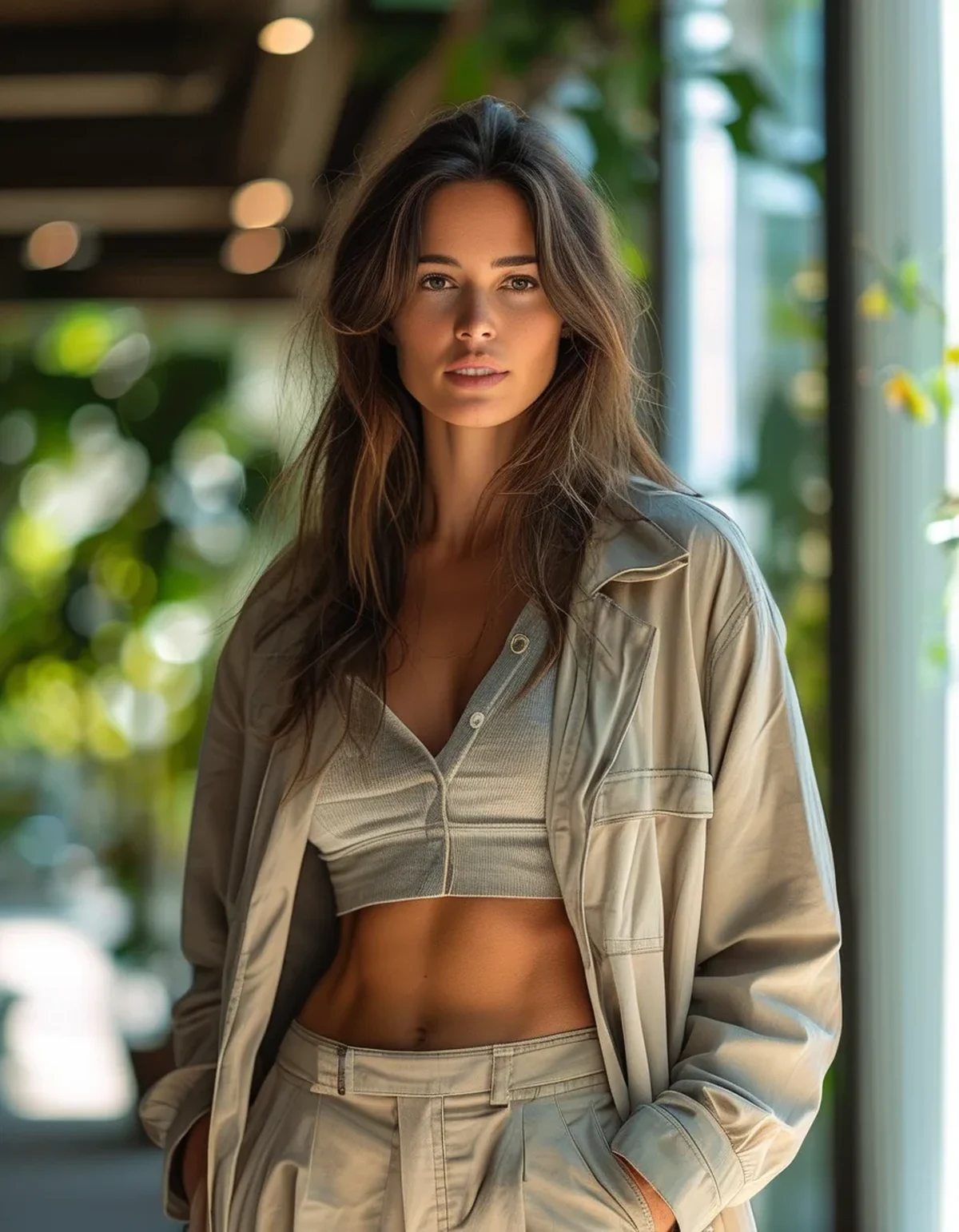
So when the look you are copying is 168cm tall and the sleeves fall past their knuckles and the hem hits mid-thigh, and you are 178cm and the same garment gives you sleeves at the wrist and a hem at the hip - you have not bought the wrong size. You have bought the correct size of a garment whose proportions were never going to translate.
The result reads as slightly small rather than deliberately large, and slightly small is the one thing oversized styling cannot survive. The entire visual logic of the look depends on the viewer registering the excess as a choice. When the excess exists in one dimension and not the other, it reads as an accident.
Which dimensions actually create the oversized look?
Three, and they are not equally important.
Shoulder drop is the primary one. In a true oversized piece, the shoulder seam sits noticeably below your actual shoulder - typically 3 to 6 centimeters out. This is what signals intent, and it is the dimension most likely to be preserved when you size up, because shoulder width grades more generously than length does. Good news: this one usually works for tall frames.
Sleeve length is where it breaks. The oversized look wants sleeves at or past the knuckles. Sleeve length grades roughly 1 centimeter per size while your arms are 5 or more centimeters longer than the pattern assumed. You would need to size up four or five times to close that gap, and by then the shoulders are falling off. This is the single most common failure point.
Body length is the second break. The hem is supposed to land somewhere unexpected - low hip, upper thigh. Body length grades slowly for the same reason. A garment intended to hit mid-thigh lands at your hip, which is exactly where a normal, non-oversized top would land. The unexpectedness disappears and the piece just looks ordinary.
A practical hierarchy, then: if you can only get two of the three right, get shoulder drop and body length, and accept sleeve length as the compromise - because sleeves can be pushed up and cuffed deliberately, which reads as styling. A hem that is accidentally at your natural waist reads as a fit problem, and there is no styling trick that rescues it.

Where does the length actually come from?
Four sources, in rough order of how reliably they work.
Tall-specific ranges. These add length without adding width, which is exactly the correction needed. The catch is that oversized styles are underrepresented in tall lines - brands assume the tall shopper wants fitted, tailored pieces. When a tall range does carry a relaxed style, buy it, because it is the only option that solves the problem cleanly.
Menswear. Men’s grading assumes greater height and longer arms at every size. A men’s small or medium frequently has the sleeve and body length that a women’s extra-large lacks, while being narrower through the hip. For sweatshirts, button-downs, tees, and unstructured jackets, this is the single most useful workaround available, and it costs nothing to try.
Sizing up deliberately, with eyes open. Two sizes up gets you roughly 2 to 3 centimeters of extra length and a great deal of extra width. Sometimes that trade is fine - a very roomy sweatshirt does not need to fit through the body. It is a poor trade for anything structured, where the shoulder will collapse before the length arrives.
Styles where length is built in. Some silhouettes carry their length by design regardless of grading - long cardigans, duster coats, maxi styles, tunic-length knits. These are drafted long as the point of the garment, so even the standard size arrives with length to spare. If you want the oversized effect and you keep failing at it, start here, because the pattern is on your side rather than against you.
What does not work: hoping. A standard-length crewneck in a larger size will not become a long crewneck, no matter how many sizes you climb.
5 Mistakes Tall Women Make With Oversized Pieces
1. Sizing up for length. Covered above, and it is worth repeating because it is the default instinct. You gain roughly a centimeter of length and five of width per size. The width arrives long before the length does, and you end up in a garment that is wide and still short - the worst of both.
2. Wearing oversized on both halves. On any frame this risks losing the silhouette entirely, but on a tall frame it also removes every reference point a viewer uses to read proportion, and the result reads as swamped rather than relaxed. One oversized piece, one piece with a defined line. This rule is not fashion dogma - it is the thing that makes the look legible.
3. Ignoring where the hem lands relative to your specific hip. The advice to hit mid-thigh assumes a particular leg length. On a longer leg, mid-thigh is further down than the garment can reach, and chasing it produces a tunic. Better approach: pick a landmark that works on your body - just past the hip bone, or clearly below the seat - and buy toward that rather than toward a rule.
4. Cuffing sleeves apologetically. If the sleeves are going to be short, make it a decision. A deliberate two-fold cuff at the forearm, pushed up, looks intentional. A sleeve that ends unremarkably at the wrist bone on a garment that is clearly meant to be roomy looks like a mistake. The difference is roughly four seconds of effort.
5. Buying the trend rather than the proportion. The most useful shift is to stop shopping for a named style and start shopping for measurements. Two brands’ interpretation of the same trend can differ by 8 centimeters in body length. Check the garment measurements - most brands publish them - against a piece you already own that fits well. It is unglamorous and it works better than anything else on this list.
FAQ: Oversized Fit Questions, Answered
What measurements should I actually check before buying?
Body length from the high point of the shoulder, sleeve length, and shoulder width. Measure a garment you own that hits correctly, then compare. Body length is the one that most often disqualifies a piece before it ships, and it is the one people check least.
Is menswear really a reasonable option, or is that a compromise?
Genuinely reasonable for unstructured pieces - sweatshirts, tees, overshirts, knitwear. It is a compromise for anything shaped through the waist or fitted at the bust, where the drafting assumes a different body. Start with the loose categories, where the difference in shaping barely registers.
Can a tailor fix an oversized piece that is too short?
No. Length can be removed but not added, unless the garment has an unusually deep hem allowance, which oversized pieces rarely do. Tailoring is for taking things in, not letting them down. Buy long and alter down - never the reverse.
Does this apply to oversized outerwear too?
More so, actually. Coats and jackets have structured shoulders that fail visibly when the width outruns the length, and sleeve length on outerwear is unforgiving because a short coat sleeve is obvious from across a room. Outerwear is the category where tall-specific ranges are most worth paying for.
TL;DR:
- Oversized garments are graded mostly in width, so sizing up gives you roughly 5cm of width per 1cm of length.
- The look depends on shoulder drop, sleeve length, and body length - and the last two are exactly what grading fails to deliver on a taller frame.
- Get length from tall ranges, menswear, or styles drafted long by design. Do not expect a size jump to provide it.
- If sleeves must be short, cuff them deliberately. A short hem cannot be styled around the same way.
- Shop by garment measurements against a piece that already fits, not by the name of the trend.
The piece is not too small. It was scaled in the one direction you did not need.
Keep Reading
This article is for general informational and styling purposes only. Fit, sizing, and product availability may vary.
