Why Sizing Up Never Fixes Tall Fit Problems - It Just Trades Them
Quick Answer: Standard size grading adds mostly width as sizes go up - a size larger typically buys you two extra inches around and barely half an inch of length. So sizing up to solve short sleeves or high hems delivers a garment that is still too short, now also too wide in the shoulders, bust, and waist. Tall ranges exist because length is graded separately from width, and the honest fixes are tall sizing, length-flexible styles, and measuring garments instead of trusting size letters.
Every tall woman has done it: the medium fits everywhere but ends an inch too soon, so you reach for the large. At home, the large is somehow still too short - and now the shoulders slouch and the waist bags. You did not pick the wrong size. You picked the wrong axis.
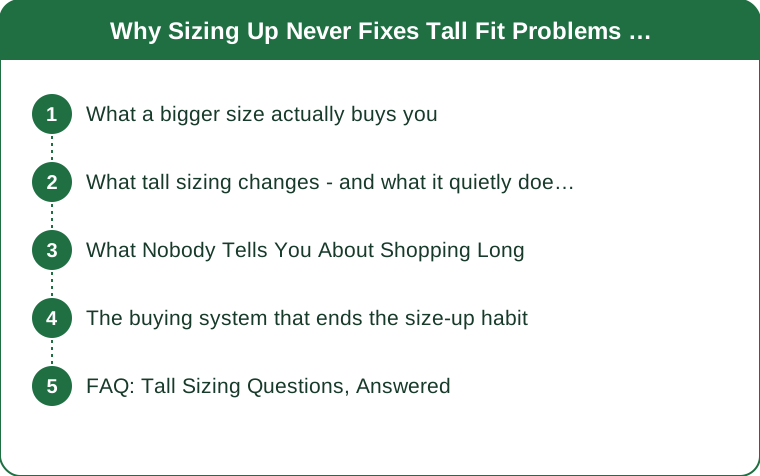
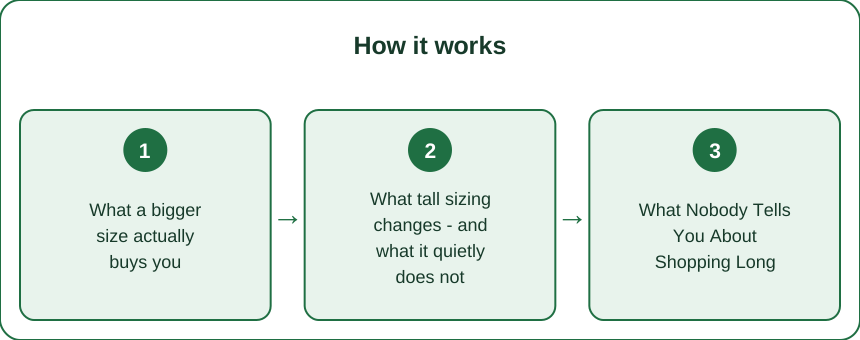
What a bigger size actually buys you
Grading - the way brands scale a design across sizes - is the whole story here, and it is worth two minutes.
Sizes grow sideways far faster than they grow long. A typical grade between women’s sizes adds roughly one and a half to two inches of circumference at bust, waist, and hip, but only around a quarter to half an inch of body length and sleeve length. The industry assumption is that bigger bodies are mostly wider, not taller - reasonable for a population average, useless for a long-limbed frame.
Run the math on the fitting-room move. If your arms need two extra inches of sleeve, sizing up one gets you perhaps half an inch - so you would need to jump three or four sizes to gain the length, by which point the garment is six inches too big around. The length you need does not exist anywhere on that rack, at any size. That is the fact the fitting room never tells you.
Shoulder seams are the visible casualty. Each size up moves the shoulder seam outward, and a seam drooping off the shoulder edge is one of the strongest oversized signals the eye reads. So the sized-up jacket manages to look simultaneously too small (sleeves) and too big (shoulders) - the exact borrowed-clothes effect you were trying to escape.
Rise and torso length behave the same way. Sizing up in leggings for leg length mostly adds waist circumference, which is why the waistband of the bigger pair folds over and slides while the ankles still hover. Length problems live on their own axis, and width money cannot buy them.
What tall sizing changes - and what it quietly does not
Tall ranges are the correct tool, with fine print worth knowing.
A proper tall grade re-lengthens the garment, not just the hem. Good tall sizing adds length in the body, the sleeve, and the rise, and it drops shoulder-to-bust and waist placement lower so the garment’s landmarks land on your landmarks. That last part is the difference between a shirt that is merely longer and a shirt that actually fits - darts at your bust, waist shaping at your waist.
Cheap tall sizing only extends the hem. Some ranges take the regular pattern and add two inches at the bottom edge and cuff. It solves coverage and nothing else - waist shaping still sits high, pockets still sit high, and knee darts in trousers land on your shin. If a tall range fits strangely, this is usually why. The tell: check whether the sleeve is longer and whether the waist placement moved, not just the hem.
Inseam labels beat size letters. Brands that publish inseams - 31, 33, 35 - let you buy length directly. For bootcut leggings and trousers especially, an inseam number is a promise a size letter never makes; a 34 to 35 inch inseam covers most tall frames with heels to spare, and the flare of a bootcut hem forgives a half-inch miss in either direction.
Online is where tall ranges actually live. Most stores stock tall sparsely or not at all, which turns the fitting room into a preview and your measuring tape into the real decision-maker. Measure a garment that fits - shoulder seam to cuff, back-neck to hem, waist to ankle - and buy against those numbers. Returns drop to almost nothing once you shop by tape.
What Nobody Tells You About Shopping Long
Knits forgive; wovens confess. A sweater half an inch short of ideal reads as intentional because knit fabric drapes and stretches. A woven shirt half an inch short reads as shrunk. When a category frustrates you in wovens, the knit version of the same silhouette often just works - which is why knitwear should be over-represented in a tall wardrobe.
Some styles have no correct length, and those are your friends. Deliberately cropped jackets, bracelet sleeves, pushed-up sleeves, ankle-slit hems, wrap styles you tie where you please. Choosing a length-agnostic design removes the entire axis of failure. This is also the honest reason yoga pants with a raw-edge cropped hem or a 7/8 cut work so well on long legs - 7/8 on the model is simply full-length on you, and nobody can tell it was not designed that way.
High-low economics apply to alterations. Shortening is cheap and lengthening is nearly impossible, so the rule is buy long, never buy hoping. A too-long pair of trousers is one 15-dollar hem from perfect; a too-short pair is landfill with a receipt.
Fabric weight changes how short reads. Heavier fabrics hang straight and make a short hem look definitive. Lighter fabrics move and blur the line. The identical inseam can pass in a fluid wide-leg and fail in a stiff straight cut.
And the quiet one: your proportions are not average tall. Two women at 5’11 can carry the height entirely differently - one long-legged, one long-torsoed. Tall ranges assume a fixed split. Knowing which half of you is long tells you which categories will betray you (tanks and one-pieces for long torsos; every inseam on earth for long legs) and which tall garments will fit like they were made for you.
The buying system that ends the size-up habit
Five habits replace the fitting-room gamble entirely.
1. Carry your numbers, not your size. Shoulder-to-cuff, back-neck-to-hem, inseam, and rise from garments you love. Two minutes with a tape measure, saved in your phone notes, consulted before every purchase. Size letters vary wildly between brands; inches do not.
2. Check the model-height note and do arithmetic. Product pages increasingly state the model’s height and the size worn. If the model is 5’9 and the dress hits her mid-calf, you know within an inch where it lands on you. This single habit filters out half of all disappointments before checkout.
3. Shop the tall filter first, then judge the garment. Loyalty to a brand whose longest inseam is 29 inches is loyalty to a subscription of small disappointments. Filter for tall or long first, then be picky about style within the results - not the reverse.
4. In activewear, length-check the stretch. Compression fabrics pull hems upward on long limbs - the squat test that everyone runs for opacity is also a length test, because a legging that goes from full-length to awkward-crop when you bend was cut for someone else’s femur. High-stretch buttery-soft leggings in a tall inseam are the rare case where you get length and recovery at once.
5. When a piece fits, buy the second one. Tall-friendly cuts get discontinued at a brutal rate because the market is thin. The repurchase-when-perfect rule feels extravagant exactly once, and then feels like wisdom every day the design no longer exists.
None of this is about hiding height or performing it. It is about ending the fitting-room math that starts with your body being the problem, when the problem was a grading chart drawn for someone else.
FAQ: Tall Sizing Questions, Answered
Why does sizing up make shoulders fit worse but not fix the sleeves?
Because each size up adds mostly circumference and shoulder width while adding only a fraction of an inch in length. The shoulder seam migrates off your shoulder edge long before the sleeve reaches your wrist - so the garment reads oversized and undersized at the same time.
Is tall sizing just longer in the hem?
In well-made ranges, no - length is added through the body, sleeve, and rise, and shaping is repositioned lower. In lazier ranges, yes, and that is why some tall garments still fit oddly. Check whether sleeve length and waist placement changed, not just the finished length.
What if a brand offers no tall range at all?
Shop that brand for length-forgiving categories only - knits, cropped-by-design jackets, wrap styles, stretch fabrics - and take your length-critical purchases (trousers, sleeves, one-pieces) to brands that publish inseams and tall grades. Split loyalty by category, not by brand.
Are longer inseams worth it in activewear if I mostly wear them casually?
Yes, arguably more so - casual wear means standing, walking, and sitting across a whole day, where a short inseam rides up constantly. A tall-inseam pair of yoga pants that stays put through a full day does more for the wearing-it-everywhere habit than any style detail.
Should I tailor everything instead of hunting tall sizes?
Tailoring shortens beautifully but almost never lengthens - there is rarely fabric to release. So tailoring complements tall shopping (buy long, perfect the hem) but cannot replace it. The tape measure and the tall filter remain the foundation.
TL;DR:
- Size grading adds about 2 inches of width per size and only a fraction of an inch of length - the length you need does not exist up the size run.
- Sizing up trades a length problem for shoulder, bust, and waist problems while barely touching the length.
- Real tall ranges re-length the body, sleeves, and rise and reposition shaping; hem-only tall ranges explain the ones that still fit wrong.
- Shop by garment measurements, model-height notes, and inseam numbers; buy long and hem, never buy short and hope.
- Knits, cropped-by-design styles, and tall-inseam stretch pieces remove the length axis entirely.
The large was never going to fix it. Your body was not the wrong size - the rack was measuring the wrong direction.
See It in Motion
Seen here: High Waist Bootcut Yoga Pants with Hidden Pocket — shop it on bubblelime.com
Keep Reading
This article is for general informational and styling purposes only. Fit, sizing, and product availability may vary.
